Flying Change Equine-Assisted Psychotherapy

Home

Potential Clients

About Us

Our Services

How It Works

New Client Forms & Referrals

Donors

Make a Donation

Become a Sponsor

Professionals

Training & Consulting

How to Start an EAP Program

Funding Opportunities for EAP Programs

Free Resources

Updates In The Field

EAP in the News

Find a Program in Your State

Contact Us


How it Works

>>Consider Amy >> How we do what we do?>> Why does it work?

Consider Amy:

How it works picture 1

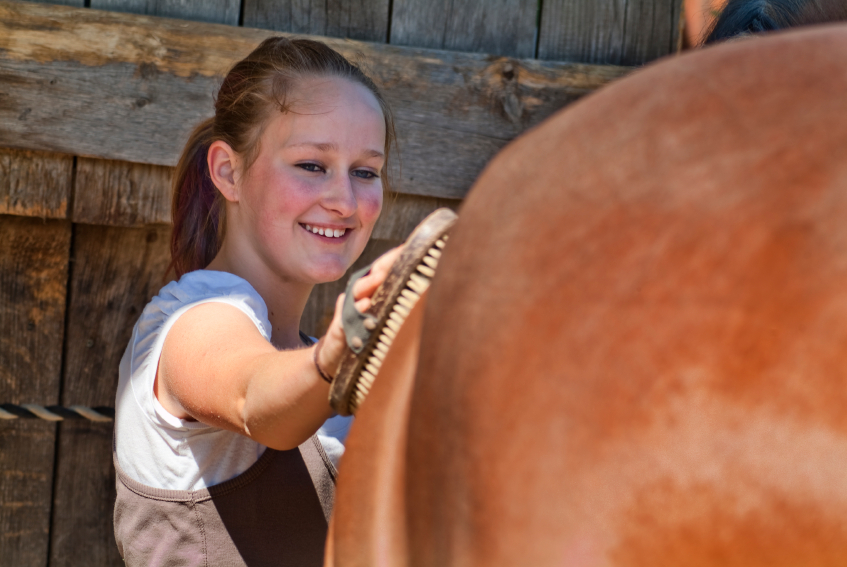
Amy is a sixteen year-old who was sent to boarding school at the age of ten, and has felt rejected ever since. Today, she has entered the barn frustrated and upset over her relationship with her boyfriend, Tony. She feels that he isn’t paying enough attention to her, and nervously eyes her cell phone on the tack trunk, in case he should call. We begin with grooming Finn, a loving horse with a very independent streak, and Amy is cooing to him sweetly, but overdoing it a little. She rubs his face over and over and over and over, until Finn has had enough. He lifts his head out of reach and turns away from her. Amy’s face falls. She follows him and begins rubbing his shoulder repetitively and baby-talking to him. Lissa approaches and says gently, “So tell me about what’s going on…”

Amy looks dismayed and says, “He doesn’t want me.” At this point, it’s hard to know whether she means Finn or Tony. “So, when he walks away, you feel rejected?” Amy nods and shoves her hands deeper in her pockets. Lissa asks, “How did you respond when Finn walked away?” Amy explains that she went after him and petted him more – “I’m trying to get him to want to be with me,” she says. Lissa responds, “So when someone is backing away from you, you pursue them?” Amy nods. “I try to be really sweet to them so that they’ll like me and want to be with me,” she says.

How it works picture 2“Is it possible,” Lissa asks, “that their behavior might not mean that they don’t like you?” Amy thinks for a moment and answers, “Yeah, I guess it could be just a mood they’re in.” Lissa nods, “So, really, it might not have anything to do with how they feel about you.” Amy thinks and nods to the possibility. “Today, when Finn responded to you by backing away, and you followed him, how did that go? Was it helpful?” Amy shakes her head, “Not really. I mean, I was still close with him physically because I went after him, but I could feel that he didn’t really want me there.” Lissa says, “What would it feel like not to follow him?” “I’m scared that if I don’t follow him, he won’t come back.” Amy’s eyes are full of tears. We have hit on a learned behavior that she has practiced for years to avoid being rejected or feeling abandoned.

How it works picture 3Amy has a need for closeness and connection, which we all have, and is struggling to learn how to meet that need with very little knowledge of how to achieve that bond. “If pursuing Finn isn’t creating the closeness you need right now,” Lissa says, “What can you do?” Amy shuffles and says, “Wait while everyone else gets finished grooming.” Emotionally, she has conceded defeat. Lissa says, “So if you can’t get a need met by the person you want to meet it, then you decide you can’t get the need met at all?” Amy looks puzzled and asks what Lissa means. “I’m wondering if there is any other way to get that need met,” Lissa responds, “if you need to connect, is there any other source of connection available to you… anything or anyone else that might be able to be with you right now, or any way that you could be there for yourself.” Amy thinks, and decides she could go to a different horse.

How it works picture 4She approaches Tootsie Roll’s stall and Tootsie marches enthusiastically to the door and juts out her nose to be petted.Amy has just had her first glimmer of realization that there are others who can meet her need for intimacy if someone she approaches is unavailable. Experientially, she has taken her first step toward empowerment – she has made a choice to advocate for her own needs, rather than make her happiness dependent on someone else. The next time Tony is unavailable to her, it will come more naturally for her to seek comfort from another of her loved ones. After a session of connecting with Tootsie through grooming and petting, Amy approaches Finn’s stall, and he greets her happily.

This is one example of how a session might go, as unique to that hour as the relationship between Amy and Finn in that moment. The session was a learning opportunity because it gave Amy an awareness of how she feels in response to another’s behavior, how she responds, a realistic view of whether her behaviors were effective, the awareness that she could choose her response, and an opportunity to choose new behaviors. Horses act as a mirror, providing direct, observable feedback about the interplay of our behavior in relationship with others. In this way, horses can motivate clients to engage in healthy behaviors.

How we do what we do…

Carl Rogers once said, “If I can provide a certain type of relationship, the other person will discover within himself or herself the capacity to use that relationship for growth and change, and personal development will occur.” In Flying Change, we strive to promote that relationship between a client and a horse, and the results are often unique and extraordinary.

Flying Change is an experiential program, meaning that clients learn about themselves through taking part in activities. Sessions may include standard activities with horses such as grooming, feeding, riding and ground training, or equine experiential activities similar in nature to ropes-course work. Learning with the horses can also include games, journaling, and art. Clients take part in an equine assisted activity, and then discuss feelings, behaviors, and patterns. The horse becomes a mirror of the feelings and behaviors the client brings with them. Often clients lack language for how they are feeling or awareness of their emotions and behaviors. Learning with the horses gives them an opportunity to safely put words to their emotions and own their behavior.

Within the interaction between a client and a horse, the client is provided opportunities to become more self-aware through understanding the metaphor of how the horse relates to them, their herd, and their environment, and how they relate to the horse. The opportunities for experiential metaphor are almost limitless. Almost anything found in our relationships with other people – our family dynamics, emotional reactions, behaviors, and choices – can be played out in an equine learning or therapy session.

The horse acts as a mirror of how we respond to others and how our behavior impacts others. The horse’s response to the client can provide valuable insight into the client’s behavior, emotions, and approach. By understanding how her behavior affects her horse, a client can begin to see how her behavior affects others, and ultimately, how that affects their response to her. Through exploring new ways to interact with her horse, she can begin to learn new constructive ways of interacting with the people in her life. The facilitator helps relate and apply this learning to the client’s own life and relationships beyond the barn environment by sharing insights and asking questions. While the facilitator makes every effort to remain non-directive, she may gently probe and ask questions to help the clients reach her own solutions.

Sessions can be structured by the facilitators in order to address certain issues and goals or left unstructured. Unstructured sessions allow for the process to unfold, and the client and horse to direct where the session goes while the equine specialist and/or therapist facilitates the learning or therapeutic process. Unstructured sessions are a little like creating art – the equine assisted activities comprise a foundation of tools that can be used by the participants, but the tools the facilitators have at their hands are used improvisationally rather than according to a set plan. The design of the session depends entirely upon the needs and goals of the client.

Our sessions are process-oriented and solution focused. Clients take part in an equine assisted activity, and then discuss feelings, behaviors, and patterns. What matters is not whether or not the client accomplishes the task, but how the clients approach the task and how they feel about the process and themselves as they participate. How does the mother who can’t get her son to get dressed for school in the morning react when her horse refuses to step over an obstacle she has been assigned to lead him over? How does that relate to what she does at home?

These are just a sample of the type and extent of sessions we include in our program. As in art, there are limitless variations to any activity and no session is ever the same.

Why does it work?

Our clients bond with our horses, and through that relationship learn to love, communicate, nurture, and trust. For some, this is the first experience of true belonging they have ever had. Clients who have felt powerless, defeated, rejected, and cast away can experience the feeling of being needed and loved. Clients who have been hurt in their relationships with people can rebuild their trust and sense of safety. Caring for a horse can be a means of learning how to give and receive nurturing for children raised in a home where nurturing was not present. Children, in particular, often turn to animals when seeking emotional support. Learning to trust their equine partner can be the beginning of renewing trust in people.

Horses are nonjudgmental, and listen without interrupting or offering advice. With them, we feel accepted unconditionally, which is not always the case with people. They are a place we can go for support when we feel threatened by seeking encouragement from people. Often our clients just need to connect with the horses, grooming, and giving and receiving safe touch. For clients who are facing life challenges, the soothing effect of stroking a horse can be very healing in itself.

Clients develop empathy through learning to understand a horse’s feelings, behaviors, and needs. Being responsible for their horses helps clients learn accountability and responsibility for their behavior. Clients can also learn about self-care through nurturing a horse.

Equine assisted learning can provide an opportunity to learn self-discipline and the ability to manage our emotions and responses. Simply stated, anxiety and anger don’t work with horses, and a person interacting with them will be required to manage their emotions to keep the horse from withdrawing.

Experiential learning with horses and achieving success, earning the horse’s respect and cooperation, can dramatically increase a client’s sense of personal power and confidence. Particularly for clients who have been victimized or experienced powerlessness in the past, the experience of personal control with a horse can boost a person’s sense of her own strength and ability to handle people and events in her life that previously made her feel powerless. This is particularly relevant to the need to set boundaries. It is an awesome experience of empowerment when a child who has been victimized by an adult twice her size learns to direct the movement of a 1000 pound horse and sets boundaries that make him respect her space. Learning to trust her horse can be a restoration of trust in something larger and more powerful than herself, and the realization that she is no longer without the power to keep herself safe.
As with any experiential approach, the best way to understand it is to experience it firsthand. We invite you to call us for additional information and to arrange for demonstrations. Please call us at (404) 512-0834 or email us at info@flyingchange.org

Copyright © 2013 Flying Change. All Rights Reserved.